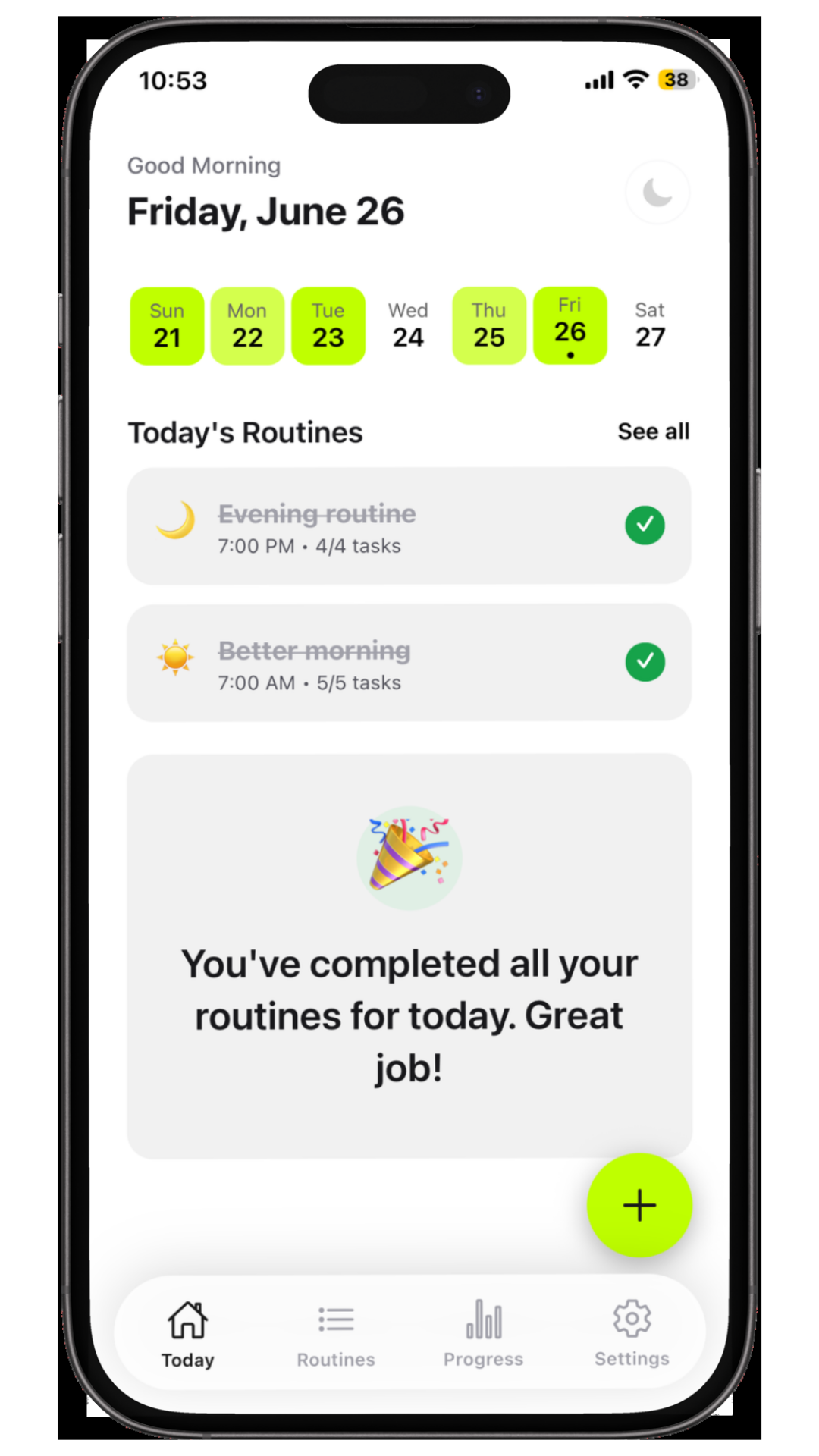
How Do I Keep Track of My Daily Routine? A Complete Guide
The Problem: Why Your Routine Tracking Isn't Working
You wake up with the best intentions. You know exactly what you need to do today. Yet by 10 AM, everything falls apart.
You forgot to take your medication. Skipped breakfast. Didn't exercise. The morning routine you planned? Gone.
The issue isn't laziness. It's not motivation. The problem is lack of visibility.
Without a clear system to track what you're doing—and what you're supposed to do next—your brain defaults to chaos. Each decision becomes a mental negotiation. Each missed task adds to the mental load. By day three, you abandon the whole thing.
But here's the thing: When you actually track your routine, everything changes.
Why Routine Tracking Works (It's Not Magic)
Before we dive into how to track, let's understand why it matters.
1. Reduces Decision Fatigue
Your brain makes thousands of decisions daily. When your routine is locked in, you remove the burden of deciding "what comes next?"
Research from Stanford's BJ Fogg and his Tiny Habits program demonstrates that external structure significantly reduces the cognitive load required to maintain consistent behaviors. According to behavioral science experts, this is why people with executive function challenges—like those with ADHD—benefit so dramatically from routine tracking.
The science: Decision fatigue research shows that each decision depletes your mental energy reserves. A consistent routine removes the need to make the same decisions repeatedly, preserving your cognitive resources for what actually matters.
2. Creates Accountability
When you log your routine, something shifts psychologically. You're no longer just "trying." You're tracking. That small act of checking off a task or logging completion creates momentum.
According to habit formation research, the act of tracking itself becomes a motivator. Each logged task provides a small dopamine hit, reinforcing the behavior. James Clear's research on habit formation shows that tracking amplifies this effect—people who monitor their progress are significantly more likely to maintain consistency.
3. Reveals Patterns
After a week of tracking, you start seeing patterns:
- Which times of day do you have energy?
- When do you consistently fail?
- What disrupts your routine most?
This data is gold. It lets you adjust, not guess.
Research from University College London found that people who track their habits for 2-3 weeks begin to see meaningful behavioral patterns. This self-awareness is what transforms tracking from a chore into a strategy.
4. Prevents the "Forget-and-Abandon" Cycle
Most people fail at routines because they miss one day, feel guilty, and quit entirely. Tracking helps because you can see your full week at a glance. One missed day doesn't break your motivation—you can see that you've completed it 5 other days.
How to Track Your Daily Routine: 5-Step Process
Step 1: Define Your Routines (Be Specific)
Start by identifying which routines matter most. Don't try to track everything.
Good routine definition:
- 7:00 AM - Wake up
- 7:15 AM - Take medication
- 7:30 AM - Eat breakfast
- 8:00 AM - Shower
- 8:30 AM - Get dressed
Bad routine definition:
- "Morning routine" (too vague)
- "Get ready" (unclear what success looks like)
Each routine should have:
- A specific start time
- 3-5 clear action steps
- A defined end state
According to BJ Fogg's behavior design research, specificity is crucial. Vague goals fail because your brain doesn't know exactly what success looks like.
Step 2: Choose Your Tracking Method
You have options. The key is choosing what you'll actually use consistently.
Option A: Digital Apps
- Pros: Reminders, auto-tracking, data insights, always with you
- Cons: Requires phone, can feel overwhelming if too many features
- Best for: People who already use their phone constantly
Option B: Pen & Paper (Calendar/Planner)
- Pros: Tactile, satisfying checkmarks, low-tech
- Cons: Manual, easy to lose, no reminders
- Best for: People who prefer writing, visual learners
Option C: Spreadsheet (Google Sheets, Excel)
- Pros: Can track multiple routines, see patterns over weeks/months
- Cons: Time-consuming to update, not portable
- Best for: Data-focused people, weekly planning
Option D: Habit-Specific Apps
- Pros: Built specifically for tracking habits/routines, reminders, progress visualization
- Cons: Can be feature-heavy or have subscription costs
- Best for: People who want automated guidance and analytics
Step 3: Log Your Completions
Daily logging doesn't need to be complicated.
At the end of each day (or as you complete the routine):
- ✅ Mark complete
- ⚠️ Note partial completion
- ❌ Log if missed
- 📝 Optional: Add notes ("Slept in," "Forgot meds," "Felt energized")
The goal isn't perfection. It's consistency and insight.
Step 4: Review Weekly
Every Sunday (or your chosen day), spend 5 minutes reviewing:
- What percentage did you complete?
- Which routines were easiest?
- Which one disrupted you most?
- What's one small change to make next week?
This isn't about judgment. It's about optimization.
Research from ADDitude Magazine on ADHD routine management emphasizes that weekly review is where real behavioral change happens. Without review, tracking becomes just busy work.
Step 5: Adjust and Iterate
Based on your review:
- Move a routine to a different time if it consistently fails
- Combine routines if one always leads to the next
- Remove routines that don't actually matter
- Add ones you realized you need
The routine is a system. Systems improve with iteration.
What Makes a Good Routine Tracking System?
If you're choosing a digital app or creating a manual system, it should have:
✅ Simple, clear logging - No more than 1 tap/check per routine
✅ Visual progress - You can see streaks or weekly completion percentage
✅ Flexibility - It adapts when your routine changes
✅ Reminders - If you choose digital, notifications at the right time
✅ Low friction - Opening it doesn't feel like work
✅ Local privacy - Your data stays on your device (not uploaded to servers)
Common Mistakes When Tracking Routines
❌ Mistake 1: Starting Too Big
You create 10 routines. By day 3, you burn out.
✅ According to habit formation research, start with 1-2. Add more after 4 weeks of consistency.
❌ Mistake 2: Perfectionism
You miss one day. The entire routine fails in your mind. You quit.
✅ A missed day doesn't erase your progress. One day out of 30 is still 97% consistency.
❌ Mistake 3: Not Adjusting
Your routine doesn't fit your life. You keep trying to force it.
✅ Review weekly and adjust. A routine that fits your actual life beats a perfect routine you hate.
❌ Mistake 4: Tracking Without Reviewing
You log every day but never look back.
✅ Weekly review (5 minutes) is what creates real change. Research shows that people who review their tracking are 3x more likely to maintain consistency.
❌ Mistake 5: Wrong Tracking Method
You choose a method you don't enjoy using.
✅ Consistency beats sophistication. Use whatever you'll actually use.
How Routine Tracking Improves Different Areas of Life
Sleep & Energy
Tracking morning/evening routines reveals how sleep quality affects your entire day. You start prioritizing sleep when you see the data.
Productivity & Focus
When you consistently complete a "focus routine" (clear desk, phone away, timer set), your brain learns to enter focus mode faster. Tracking proves this works.
Mental Health & Anxiety
Routines create predictability. Predictability reduces anxiety. According to neuroscience research, tracking gives you evidence: "I completed my evening routine 5 days this week, and I slept better those nights."
Physical Health
Tracking morning exercise, meal prep, or medication adherence keeps health goals visible. You're not relying on memory—you have data.
Relationships
When your personal routines run smoothly, you have mental space for people. Tracking routines protects time for what matters.
Tools That Work: What's Available
Free Options
- Google Calendar: Simple, visual, works on any device
- Pen & paper checklist: Tactile, requires daily review
- Apple Reminders: Built-in, native iOS integration
- Spreadsheet: Maximum flexibility, manual tracking
Freemium Apps
Many routine and habit tracking apps offer free versions with limitations (tracking up to 2-3 habits, basic features), with paid upgrades for more routines and advanced analytics.
Things to Look For
- Reminders (notification-based nudges)
- Progress visualization (streaks, percentages, charts)
- Offline capability (data stored locally on your device)
- Simplicity (not overwhelming with features)
The Bottom Line
How do you keep track of your daily routine?
- Define it clearly (specific times, specific actions)
- Choose a tracking method you'll actually use
- Log daily (one tap, one check, one line)
- Review weekly (5 minutes of reflection)
- Adjust based on reality (your life changes, your routine should too)
That's it. Not complicated. Just consistent.
The magic isn't in the tool. It's in the system. When you know what you did yesterday, what you're doing today, and what progress you've made this week, everything changes.
Your routine isn't about perfection. It's about reducing mental load, creating accountability, and building sustainable habits one tracked day at a time.
FAQ
Q: How long does it take to see results from tracking?
Q: Should I track every single day?
A: Consistency matters more than perfection. Aim for 6 days out of 7. Missing one day is fine. Two consecutive missed days is when motivation often drops. Research shows that maintaining a streak (even if imperfect) keeps motivation high.
Q: What if my routine doesn't work?
A: Adjust it. A routine that fits your actual life beats a perfect routine you resent. Review weekly and make small changes.
Q: Can I track routines if I have ADHD or executive function challenges?
A: Absolutely. In fact, tracking is one of the most effective strategies for managing routine when you have ADHD. The key is removing barriers—use reminders, keep it simple, and accept that missed days happen.
Q: Is digital or manual tracking better?
A: Whichever you'll actually use. Digital offers reminders and analytics. Manual offers tactile satisfaction. Both work if you're consistent.
Ready to Start?
Pick one routine. Define it clearly. Choose a tracking method. Log for one week.
That's all. You don't need a perfect system. You need a simple system you'll actually use.
Everything else will follow.
Sources & Further Reading
- BJ Fogg - Tiny Habits Research - https://www.tinyhabits.com/
- Behavior design and habit formation science
- James Clear - Atomic Habits - https://jamesclear.com/habits
- Evidence-based habit tracking and consistency research
- University College London - Habit Formation Study - https://www.ucl.ac.uk/news/2009/aug/how-long-does-it-take-form-habit
- "How long does it take to form a habit?" Research
- ADDitude Magazine - ADHD Routine Guide - https://www.additudemag.com/adhd-routines/
- Building ADHD-friendly routines and tracking strategies
- American Psychological Association - Self-Control & Decision Fatigue - https://www.apa.org/science/about/psa/self-control
- Research on mental energy and decision-making
- Focus Bear - ADHD Habit Tracking - https://www.focusbear.io/blog/adhd-habit-tracker
- ADHD-friendly tracking design and benefits
- Google Calendar - https://calendar.google.com/
- Free visual routine planning tool
- Apple Reminders - https://support.apple.com/en-us/HT205890
- Built-in iOS reminder system
Disclosure: Roz is a routine tracking app designed with ADHD-friendly features. We recommend various tools in this guide based on what works best for different people. All links are provided for informational purposes.

Ready to build habits that stick?
Join thousands of people with ADHD using Roz to track routines and build streaks.
Get started freeMore from the blog
View all in guide
Good Work Routines: 7 Workout Routine Examples + A Tracking System
A good workout routine reduces friction, protects your time, and builds momentum. But here's what separates people who stick with workout routines for months versus those who quit after two weeks: they track it
 Ahmer Saud
How a Simple Night Routine Can Transform Your Sleep
When you repeat the same sequence of activities every evening, your body begins to recognize that sleep is approaching. Over time, these repeated cues help your brain transition into a relaxed state, making it easier to fall asleep consistently.
Ahmer Saud
How to Actually Build Habits That Stick: The Atomic Habits Framework Explained
Learn the proven Atomic Habits framework to build lasting routines. Step-by-step guide + actionable system.
Ahmer Saud