Good Work Routines: 7 Workout Routine Examples + A Tracking System
You know you should work out. You know the structure matters.
But knowing something and actually doing it consistently are two completely different things.
Most people fail at workout routines not because the exercises are wrong, but because they can't see whether they're actually following the routine. Research consistently shows that self-monitoring increases the likelihood of behavior change by 20–40%. Yet most people never track whether they completed their workout routine — they just guess, quit, and start over next Monday.
A good workout routine reduces friction, protects your time, and builds momentum. But here's what separates people who stick with workout routines for months versus those who quit after two weeks: they track it. When you can see "I completed my workout routine 5 out of 7 days this week," something clicks. You don't need motivation anymore — you have evidence that it works.
The Real Problem with Workout Routines
You probably already know that structure matters for workout routines. The problem isn't understanding this — it's staying consistent with it over weeks and months.
Here's what usually happens:
- Week 1: You're excited. The routine feels great. You work out every day.
- Week 2: You miss one day. You're not sure why. Maybe you were busy, maybe you weren't feeling it.
- Week 3: You skip again. And again. You're back to improvising.
- One month later: You don't remember why you stopped.
The missing piece? You never had visibility into whether you were actually following it.
When you don't track your workout, you're left guessing. "Did I actually do it? Am I consistent?" Without data, the answer is always "I don't know," and that uncertainty kills motivation.
But the moment you can see your completion rate — "I did this 4 out of 7 days last week" — you shift from motivation to accountability. You can adjust. You can improve. You can build a routine that actually works.
What Makes a Workout Routine "Good"?
We've reviewed thousands of workout routines, from gym workouts to home training to running programs. The best ones share five qualities:
Repeatable — You can follow it without needing a perfect body or unlimited time
Realistic — It matches your actual schedule, fitness level, and equipment (not a fantasy version of you)
Friction-reducing — It removes decisions and makes starting easier
Recovery-protecting — It includes rest and prevents burnout before it starts
Progress-enabling — It's sustainable long enough to see results
If your routine lacks any of these, it won't last past week two.
The sixth quality we see in people who actually stick with fitness routines? Visibility. They can see whether they completed it. Without this, you're working blind.
The 5 Core Elements That Make a Workout Routine Work
Every sustainable workout routine is built around five moments:
1) Pre-Workout Preparation (5 minutes)
A short ritual that signals to your body: "Exercise mode is on." Grab water, change clothes, set your timer. Remove the friction to starting.
2) Warm-Up (5–10 minutes)
Light movement that prepares your muscles and joints. This isn't optional — it's where you transition mentally into the workout.
3) Main Workout (20–60 minutes depending on routine)
The core work. Strength training, cardio, flexibility, or a mix. One focus: complete this session.
4) Cool Down / Stretch (5–10 minutes)
Often skipped, but crucial. This is where your body recovers and your mind registers "workout complete."
5) Post-Workout Tracking (2–3 minutes)
Did you finish? Record it. How did it feel? Note it. What's tomorrow? Plan it. This tiny moment of logging is where consistency becomes visible.
Why these five? Because they happen at natural transition points. They're where most people lose structure and slip back into "I'll do it tomorrow."
7 Good Workout Routine Examples (Ready to Use)
1) Gym Strength Training Routine
Best for: People with gym access who want to build muscle
Time commitment: 60–75 minutes total
The Challenge: Gym routines fail when people show up without a plan, waste 20 minutes deciding what to do, then leave without progress.
The Routine Structure
Pre-Workout (3 min)
- Pack gym bag night before (removes decision)
- Arrive 5 min early
- Set timer for 60 min
- Drink water
Warm-Up (5 min)
- 2 min light cardio (treadmill, rowing machine)
- 3 min dynamic stretching
Main Workout (50 min)
- Pick one focus: Upper body, Lower body, or Full body
- 4–5 exercises per session
- 3–4 sets per exercise
- Rest 60–90 seconds between sets
- One exercise at a time (no multitasking)
Cool Down (5 min)
- Light stretching
- Static holds
Post-Workout (2 min)
- Log: Did you finish? Yes/No
- Note: How many sets/reps actually completed
- Plan: What's the next session's focus
How Roz Users Stick With It
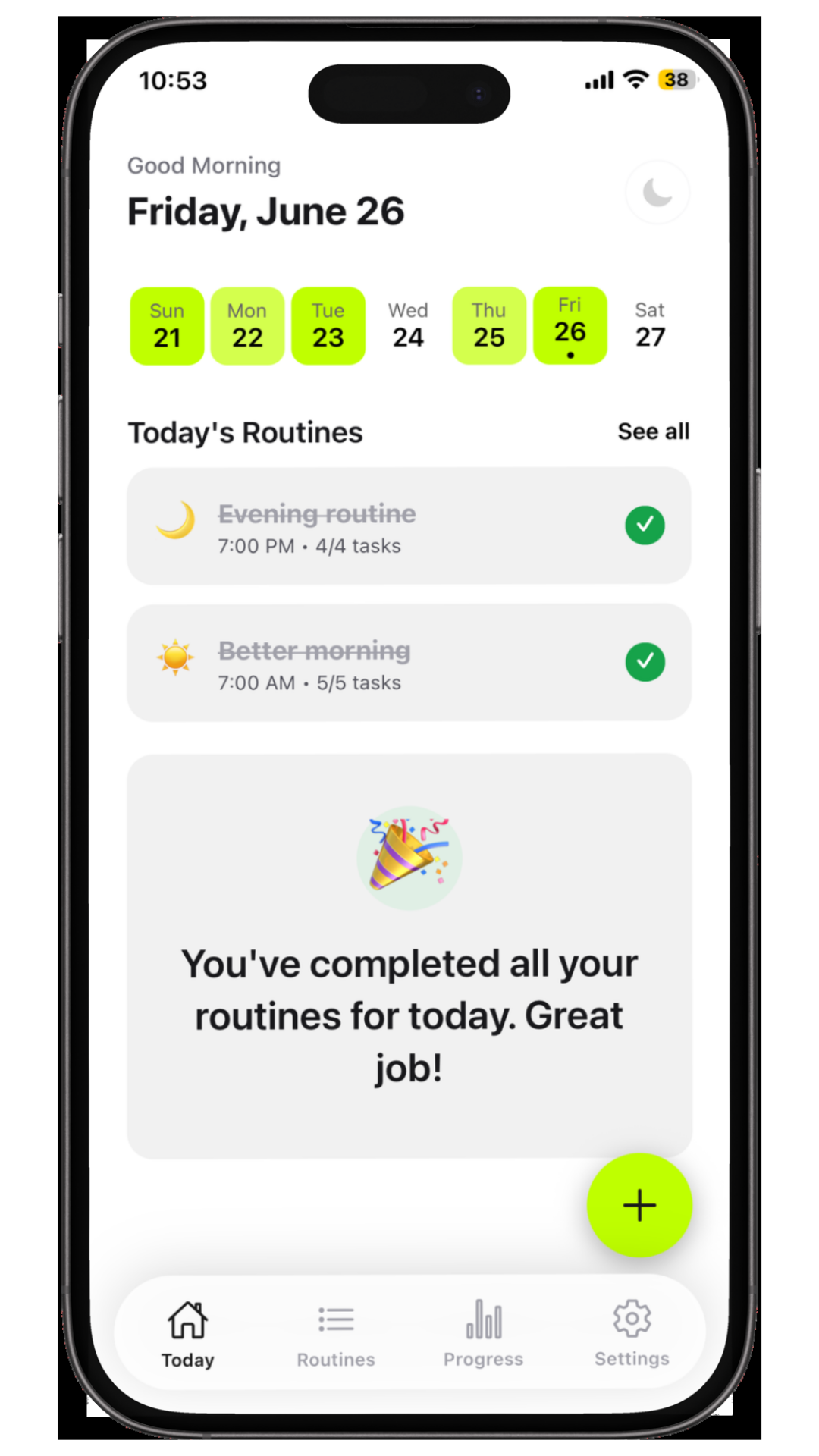
Roz users set their gym routine as a timed sequence: warm-up (5 min timer) → upper body focus (50 min timer) → cool down (5 min timer). The app reminds them it's gym time, the timer shows progress, and the completion log shows: "I completed my gym routine 4 out of 5 scheduled days this week."
By week 3, they've built evidence they can stick to something. That evidence is more powerful than motivation.
2) Home Workout Routine (No Equipment)
Best for: People with limited time or no gym access
Time commitment: 30–40 minutes total
The Challenge: Home workouts fail because there's no barrier to distraction. Your couch is right there. Your phone is right there. You need stronger structure.
The Routine Structure
Pre-Workout (2 min)
- Phone in another room (not silence — completely out of reach)
- Water bottle ready
- Clear a small space
Warm-Up (5 min)
- Jumping jacks: 30 seconds
- Arm circles: 30 seconds
- Bodyweight squats: 1 minute
- High knees: 1 minute
- Stretch: 2 minutes
Main Workout (25–30 min) Choose one focus per day:
- Monday: Lower body (squats, lunges, glute bridges)
- Wednesday: Upper body (push-ups, rows, shoulder work)
- Friday: Full body cardio (burpees, mountain climbers, jump rope)
Cool Down (5 min)
- Static stretching
- 2 minutes of deep breathing
Post-Workout (2 min)
- Log completion
- Note: How many rounds/reps
- Capture how you felt
Busy-Day Version
15 minutes: 3 min warm-up + 10 min main workout + 2 min cool down. Still counts. Still matters.
How Roz Users Stick With It
Home workouts need stronger accountability because there's no external pressure (no gym staff, no commute). Roz users set their home routine with notifications: "It's 7 AM — time for your 30-minute home workout." The app's timer keeps them moving through each section without checking the time. At the end, they log it. By week 2, they see: "I've completed this 9 out of 14 days. That's 64% — I'm building a real habit." That visibility matters more than the actual workout.
3) Running Routine (Outdoor)
Best for: People who want to build running habit and consistency
Time commitment: 30–50 minutes total
The Challenge: Running routines fail because people go too hard too fast, burn out, and never return. Research shows that people who focus on changing one thing at a time are 80% more successful than those who try to change multiple behaviors simultaneously.
The Routine Structure
Pre-Run (5 min)
- Hydrate
- Stretch legs lightly
- Set route or distance goal
- Check timer
Warm-Up Run (5–10 min)
- Easy pace (you should be able to talk)
- This is not about speed — it's about starting
Main Run (20–30 min)
- Steady pace
- One route (removes decision)
- No phone checking mid-run (just run)
Cool Down (5 min)
- Slow walk to bring heart rate down
- Stretching (hold 30 seconds per muscle)
Post-Run (2 min)
- Log: Distance or time completed
- Note: How you felt
- Plan: Next run's focus
The "Beginner" Version
If you're starting from zero, the routine is:
- 2 min warm-up walk
- 10 min run/walk alternating (1 min run, 1 min walk)
- 2 min cool-down walk
- Log it
This takes 15 minutes. This counts. This builds the habit.
How Roz Users Stick With It
It takes an average of 66 days to form a habit — not 21. Missing a single day does not derail the process. Consistency over perfection is what matters, with a 70% completion rate being an excellent foundation. Roz users track their runs in their routine, not for speed records, but for consistency. "I ran 17 out of 21 days last month = 81% consistency." That number is what keeps them coming back, not motivation.
4) Morning Fitness Routine (Quick & Energizing)
Best for: People who want to start their day with movement but have limited time
Time commitment: 15–20 minutes total
The Challenge: Morning workouts fail because people sleep through alarms or feel too tired to start. The solution: lower the barrier to starting.
The Routine Structure
Pre-Workout (1 min)
- Alarm goes off
- Drink water immediately
- Change into workout clothes
Movement (12–15 min)
- 3 min light cardio (dancing, jumping jacks, walking in place)
- 8 min bodyweight exercises (5 exercises, 90 seconds each: squats, push-ups, lunges, planks, mountain climbers)
- 2 min stretching
Post-Workout (1 min)
- Log: Completed? Yes/No
- Quick note: Energy level
Busy-Day Version
5 minutes: Just do 3 min cardio + 2 min stretching. That's it. You still moved. You still tracked it.
How Roz Users Stick With It
Morning routines live or die on friction. If you have to decide "should I work out today," you lose. Roz users set this routine to auto-start at 6:30 AM with a notification. The routine is pre-planned: no decisions, just follow the steps. By week 2, it's automatic. By week 4, they've logged 25+ completions. They're not doing it for fitness yet — they're doing it because the routine exists and the app shows they're doing it.
5) Evening Stretching & Mobility Routine
Best for: People who sit all day and need recovery
Time commitment: 15–20 minutes
The Challenge: Evening routines are skipped because people are tired. The routine needs to feel restorative, not demanding.
The Routine Structure
Setup (2 min)
- Find quiet space
- Light dimming if possible
- No screens
Full-Body Stretch (15 min)
- Neck rolls: 1 min
- Shoulder stretches: 2 min
- Chest opener: 2 min
- Forward fold: 2 min
- Hip opener: 2 min
- Quad/calf stretch: 2 min
- Spinal twist: 2 min
Wind-Down (3 min)
- Deep breathing (5 slow breaths)
- 2 minutes lying down, quiet
Post-Routine (1 min)
- Log completion
- Note: Mobility improved? Energy level?
How Roz Users Stick With It
Evening routines often feel like a chore, but tracking flips that. Roz users log this routine and see: "I stretched 6 out of 7 nights last week." That small consistency builds confidence. More importantly, they notice the effect: "I slept better, I'm less sore, I feel calmer." The tracking isn't punishment — it's evidence.
6) Weight Loss Routine (Gym + Nutrition Checkpoint)
Best for: People combining fitness with dietary goals
Time commitment: 75 minutes total (includes one meal prep component)
The Challenge: Weight loss routines fail because people track workouts OR diet, but not both. The routine needs both components visible.
The Routine Structure
Morning
- Workout (same as gym routine above): 60 min
Evening Checkpoint
- Review what you ate (5 min reflection, not calorie counting — just noticing)
- Plan tomorrow's meals (5 min)
- Log both: Workout completed? Meals tracked?
How Roz Users Stick With It
Roz users set this as a full-day routine with two touchpoints: morning workout and evening review. The evening checkpoint isn't about judgment — it's about awareness. By tracking both, they see patterns: "When I work out, I make better food choices." The routine isn't restrictive; it's revealing. That visibility drives change more than willpower ever could.
7) Beginner Fitness Routine (Starting From Zero)
Best for: People with no fitness habit currently, chronic avoidance, or starting after a long break
Goal: Build confidence, prove to yourself that consistency works
The Routine (Intentionally Minimal):
- Pick ONE workout (not three, not five — one: either a 20-min home workout, a 30-min walk, or a gym session)
- Do it at the same time each day (removes decision)
- Log it immediately (yes/no — that's the only data point)
That's it. Repeat for 7 days exactly.
On day 8, you'll have 7 data points showing you can be consistent. Then add another component.
Sample Week 1
- Monday: 20-min home workout ✓
- Tuesday: 20-min home workout ✓
- Wednesday: 20-min home workout (skipped)
- Thursday: 20-min home workout ✓
- Friday: 20-min home workout ✓
- Saturday: 20-min home workout ✓
- Sunday: 20-min home workout ✓
Result: 6 out of 7 = 86% consistency
That's a strong foundation. Now you know: You CAN stick to something.
How Roz Users Stick With It
Beginner routines live on simplicity. Roz users pick their one routine, set it daily at the same time, and just log whether they did it. No tracking intensity, no tracking calories, no tracking improvements yet. Just: Did I do my routine today? Yes or no.
By day 7, they have visual proof of consistency. That proof matters infinitely more than the actual fitness gains (which take time). Roz shows: "You've completed this routine 6 times this week. You're already in the top 20% of people who start fitness routines."
That one stat changes everything.
How to Build Your Own Workout Routine (Step-by-Step)
Step 1: Choose Your Workout Routine Type
Pick one from this article, or combine elements:
- Gym strength training?
- Home bodyweight?
- Running?
- Stretching and mobility?
- A mix?
Step 2: Define Your Time
Be honest. Not ideal time — actual available time.
- 15 minutes available? Pick the Quick Morning routine.
- 30–45 minutes? Pick Home Workout or Running.
- 60+ minutes? Pick Gym Routine.
Step 3: Pick a Time AND Place
Specificity matters. Not "I'll work out sometime in the morning." Instead: "I work out at 6:30 AM in my living room" or "Tuesday/Thursday at 6 PM at the gym."
Time + place removes decisions.
Step 4: Make a Busy-Day Version
Life will happen. You'll be sick, tired, busy. Have a 10–15 minute version you can follow even in chaos.
Full routine: 60 min gym session
Busy-day version: 15 min home bodyweight work
Both count. Both build consistency.
Step 5: Test for 7 Days (Don't Optimize)
Don't tweak daily. Don't change exercises every other day. Just do the routine exactly as planned for a full week.
After day 7, you'll have real data:
- Did you actually complete it?
- Which parts broke?
- What needs adjusting?
Then adjust for week 2.
Why Workout Routines Fail (And How Tracking Fixes It)
Most people abandon fitness routines after 2–3 weeks, not because the routine is wrong, but because they can't see if it's working.
Here's the failure cycle:
- You build a routine
- You follow it for 3–4 days (feels great)
- On day 5, you miss it
- You're not sure if this is normal or if you're failing
- By week 2, you've abandoned it
The missing piece: Tracking.
When you can see your completion rate, you get real feedback:
- "I'm 86% consistent with my gym routine" (good — keep it)
- "I only completed 40% of my home workouts" (honest signal — this time doesn't work for me)
- "I never finished my evening stretching" (restructure it — maybe it's too late)
With data, you can adjust. Without it, you just quit.
How to Actually Stay Consistent With Your Workout Routine
Building the routine is 20% of the work. Staying consistent is 80%.
1) Start Embarrassingly Small
Your first routine should feel easy. This builds momentum.
If you think you need 60 minutes of gym time, start with 30. You'll naturally extend it once the habit sticks.
2) Track Completion, Not Perfection
You're not trying to follow 100% of your routine every single day. A heatmap shows that you completed your habit 26 out of 30 days, with the four misses scattered across different weeks. That picture communicates consistent effort, not failure.
Track whether you did the routine. Some weeks you'll hit 70%, some 95%. That variance tells you something important.
3) Use Reminders and Timers
Your brain needs external cues. Notifications say "it's time." Timers create urgency and boundaries.
Remove the decision: timer tells you when to move to the next section.
4) Build a "Busy Day" Version
Chaos always comes. Have a 15-minute version of your routine ready for when life explodes.
On chaos days, you do the busy version. Still structured, still effective.
5) Review Your Data Weekly
Spend 2 minutes every Sunday looking at:
- Which parts did you complete? (celebrate these)
- Which parts did you skip? (adjust these)
- What external factors affected your consistency? (note patterns)
Then adjust for the week ahead.
Tools That Help You Stick to Workout Routines
A workout routine only works if you can execute it consistently.
Most people rely on willpower to follow workout routines. That fails around day 5.
Good tools do three things:
- Make the next step obvious (remove decisions about what exercise is next)
- Create external accountability (notifications, timers, reminders)
- Show you data (so you can see what's working and adjust)
Traditional fitness apps focus on what to do. They don't focus on whether you actually do it consistently.
A routine tracker like Roz is different:
- Step-by-step guidance: You don't decide what's next — your routine tells you (warm-up → main workout → cool down)
- Built-in timers: External cues trigger action, not willpower
- Completion tracking: You see what you actually follow (not what you planned)
- Weekly/monthly insights: Data shows patterns ("I'm 80% consistent with my morning routine" or "I skip my evening stretching on Thursdays")
- Flexibility: On hard days, you can shorten or modify — and still track it
The routine adapts to your week. You see the data. You improve.
Common Mistakes When Building Workout Routines
Workout Routine Too Ambitious
You create a 120-minute workout, follow it for 2 days, then quit.
Fix: Start with 25–30 minutes total. Add to it once it sticks.
No Recovery Built In
All intensity, no rest. This leads to burnout by week 2.
Fix: Include a cool-down and stretching in every routine.
No Flexibility
Your routine is rigid. Life isn't. First obstacle = routine breaks forever.
Fix: Create a busy-day version you can follow even in chaos.
No Tracking of Your Workout Routine
You can't see if it's working, so you assume it isn't.
Fix: Track completion for one week. You'll see patterns and adjust from data, not feeling.
Optimizing Daily
You change the routine every day, so it never becomes automatic.
Fix: Run it for 7 days without changes. Then review and adjust once.
The Real Promise of Workout Routines
Most people think workout routines are about working harder or doing more exercises.
They're not.
Good fitness routines do three things:
- Reduce friction — You don't think about whether to work out. Your routine tells you to.
- Protect your time — Without structure, work, family, distractions consume your exercise time. Routines create boundaries.
- Build momentum — Even on low-energy days, you follow the routine. Structure + repetition = results.
But the fourth thing? The thing that actually keeps people consistent?
Seeing the data.
When you can see "I completed my workout routine 5 out of 7 days this week," something clicks. You don't need motivation anymore — you have evidence that it works.
Start Here
You don't need a perfect workout routine.
You need a repeatable one.
Pick one from this article that matches your situation (gym, home, running, morning, evening, weight loss, or beginner).
Run it for 7 days exactly. Don't optimize. Don't quit on day 5. Just follow it.
After day 7, you'll have real data:
- What parts you actually completed
- What parts broke
- Where your week got chaotic
Then adjust for week 2.
The magic of consistency isn't willpower. It's structure.
And you know structure works because you have 7 data points proving it.
Resources
- Habit Tracking Methods Compared - BeBetterHabits — Research on self-monitoring and behavior change
- 30-Day Habit Tracker Printable - Positivity.org — Science-backed insights on habit formation (66 days, not 21)
- 30-Day Habit Challenge Guide - Habit Streak — Research on focusing on one habit at a time
- The Complete Guide to Habit Tracking 2026 - Habit Streak — How tracking creates visibility and momentum
- Roz - Daily Routine Tracker App — Routine tracking and consistency app for any goal
- Roz for Workouts — Pre-built workout routine templates and tracking
- Cal Newport - Deep Work — On focused work blocks and protecting attention
- BJ Fogg - Tiny Habits — Behavioral design for sustainable habit formation

Ready to build habits that stick?
Join thousands of people with ADHD using Roz to track routines and build streaks.
Get started freeMore from the blog
View all in guide
How a Simple Night Routine Can Transform Your Sleep
When you repeat the same sequence of activities every evening, your body begins to recognize that sleep is approaching. Over time, these repeated cues help your brain transition into a relaxed state, making it easier to fall asleep consistently.
 Ahmer Saud
ADHD Routine Tracker Apps: The Ultimate Guide to Breaking Executive Dysfunction with an "External Brain"
You set the alarm for 7:00 AM. It goes off. You snooze it. At 7:30, you know you need to get up, shower, and eat breakfast. But you lie there, scrolling, paralyzed. Your brain screams "Get up!" but your body doesn't move.
Ahmer Saud
Do Routines Really Help with Anxiety? What the Research Says
Let's dig into the science, the mechanisms, and how to use routines specifically to manage anxiety.
Ahmer Saud